Batteries have become one of the main parts of renewable energy systems, and therefore battery lifespan has become an important issue for home users, businesses, and industry representatives. There is no fixed lifespan of a modern energy storage battery since the lifespan of a battery may vary depending on battery chemistry, usage, operating temperature, charging and discharging patterns, and overall system management.
For instance, for lithium-ion batteries, the lifespan typically ranges from 8 to 15 years depending on how the battery is used and the conditions it operates under.
Understanding Grid Independence
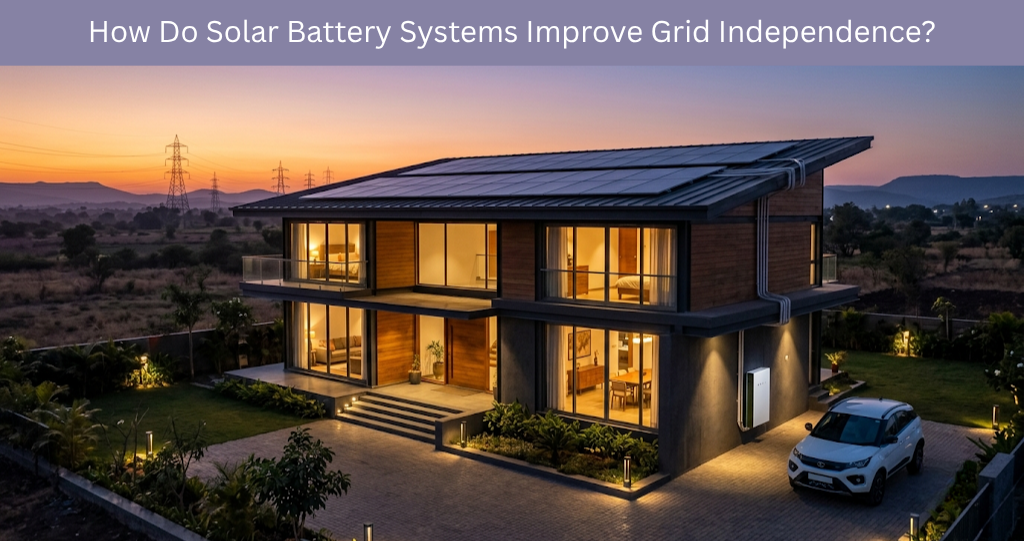
It should be noted that grid independence does not imply the total disconnection from the power grid for most users. Besides complete independence from the conventional energy source, grid independence also means the ability to minimise one’s consumption of energy supplied by the power grid and have an alternative source of electricity in case of an interruption in the power supply by the grid.
A solar battery system works on a simple principle:
- Generate: The solar panels generate electricity during the day.
- Store: The surplus electricity that comes in excess is directed to the battery.
- Use: The electricity stored in the battery can be used in cases of insufficient solar energy generation.
Thus, solar energy is helpful at night or when there is supply fluctuation.
How Long Do Lithium Batteries Last?
s used and how much it is discharged.
Unlike normal batteries, which can be rated based on the number of years in use, energy storage batteries can also be rated based on their cycle life. One cycle is equal to one full charge and discharge. Battery life is affected by a range of factors.
- Charging cycles
- Discharge depth
- Operating temperature
- Charging and discharging rate
- Battery composition
- Maintenance
- Quality of the Battery Management System
When batteries work under ideal conditions, they are able to function for extended periods of time.
Solar Off-Grid Systems for Remote Applications
Lithium battery cycle life refers to the number of cycles that a battery can complete before its capacity reaches a certain limit.
This means that a battery can have some thousands of charging cycles, but its use does not stop there. Its performance might be reduced gradually afterwards rather than failing all of a sudden. The following factors play a significant role in lifecycle tracking:
|
Factor |
Effect on Life Span |
|
Frequent discharge |
Increases battery ageing |
|
Moderate discharge |
Allows for longer lifespan |
|
High temperatures |
Speeds up ageing |
|
Proper charging |
Lowers stress on the battery |
|
Good battery management |
Guarantees performance |
Taking into consideration battery cycle life and calendar lifespan will allow you to understand battery performance better.
What Determines Battery Storage Lifespan?
Battery storage life depends on more than just the battery cells themselves. The entire storage unit and its environment have a big impact
1. Battery Chemistry
Lithium-ion technology is very popular due to its high energy density, efficiency, and ability to be charged and discharged repeatedly.
2. Depth of Discharge
Using batteries from almost fully charged to empty all the time puts more strain on the cells. It can help prolong the useful life of batteries by maintaining the recommended operating limits.
3. Temperature
Heat can hasten the degradation of batteries. Therefore, thermal management should be taken into consideration during their application when it comes to energy storage.
4. The Battery Management System
A battery management system allows users to keep track of important parameters such as voltage, temperature, and charging and discharging of batteries. Proper monitoring will help ensure safer battery operation.
Why Battery Quality Matters
The conditions of the battery cells, battery pack design, thermal management, electronic elements, and safety systems can all affect the performance of batteries over time. Therefore, it is crucial to choose a manufacturer that has a lot of experience in energy storage.
As the demand for energy storage grows, Lithium-Ion Battery Manufacturers in India concentrate on making their batteries safer, more efficient, and reliable.
Different applications need different batteries depending on their loading, usage conditions, and expectations.
How to Extend Battery Life
Users can do several easy things to ensure their batteries last longer:
- Avoid deep discharge.
- Keep the battery temperature within limits.
- Use suitable recharging devices.
- Stick to the recommended usage limits.
- Check battery performance status frequently.
- Use the proper battery capacity for the application.
- Use the right energy management system.
Proper practices will keep unnecessary stress off the battery and provide usable capacity for a longer period.
Choosing the Right Energy Storage System
Modern energy storage systems need reliable battery technology and appropriate design of the system. Waaree Technologies has Battery Energy Storage Systems for use in projects like commercial energy storage systems, power plants, and street lights.
Choosing the right battery capacity and managing the charging/discharging means one can increase the reliability of energy storage equipment and provide long-lasting results.
Conclusion
The actual lifespan of modern batteries depends vastly on the technology used, operating conditions, and application. Lithium-ion batteries provide several years of reliable operation, with most of the systems designed to serve for about 8 to 15 years.
Knowing lithium battery cycle life, DOD, temperature, and battery management is essential for making sound storage decisions.
FAQs
- 1. How Long Do Lithium Batteries Last?
Lithium batteries can last up to 8 to 15 years, depending on their use, temperature, charging methods, and battery technology.
- 2. What Is Lithium Battery Cycle Life?
Lithium battery cycle life is the number of durable charging/discharging cycles one battery goes through until the usable capacity declines.
- 3. What Factors Influence Battery Lifespan?
Battery chemistry, DOD, operating temperature, charging methods, cycle frequency, and battery management system determine its lifespan.
- 4. Can Battery Storage Last for More Than 10 Years?
Yes, it is even possible to run modern lithium-ion energy storage systems longer than 10 years, provided they are properly designed, installed, and maintained.
- 5. Why Is Battery Quality Important for Energy Storage?
Battery quality defines its efficiency, safety, cycle performance, reliability, and efficiency in long-term energy storage, determining the manufacturer and the system design importance.






Blog Comment Form